Governance & risk
Leadership, policy, compliance evidence
Monthly partnership / Resident security
A business-aware operating partner connecting security engineering, operations and CISO-level decision support—with accountable human leadership.
Different service tiers, tailored to your business.
Discuss your needs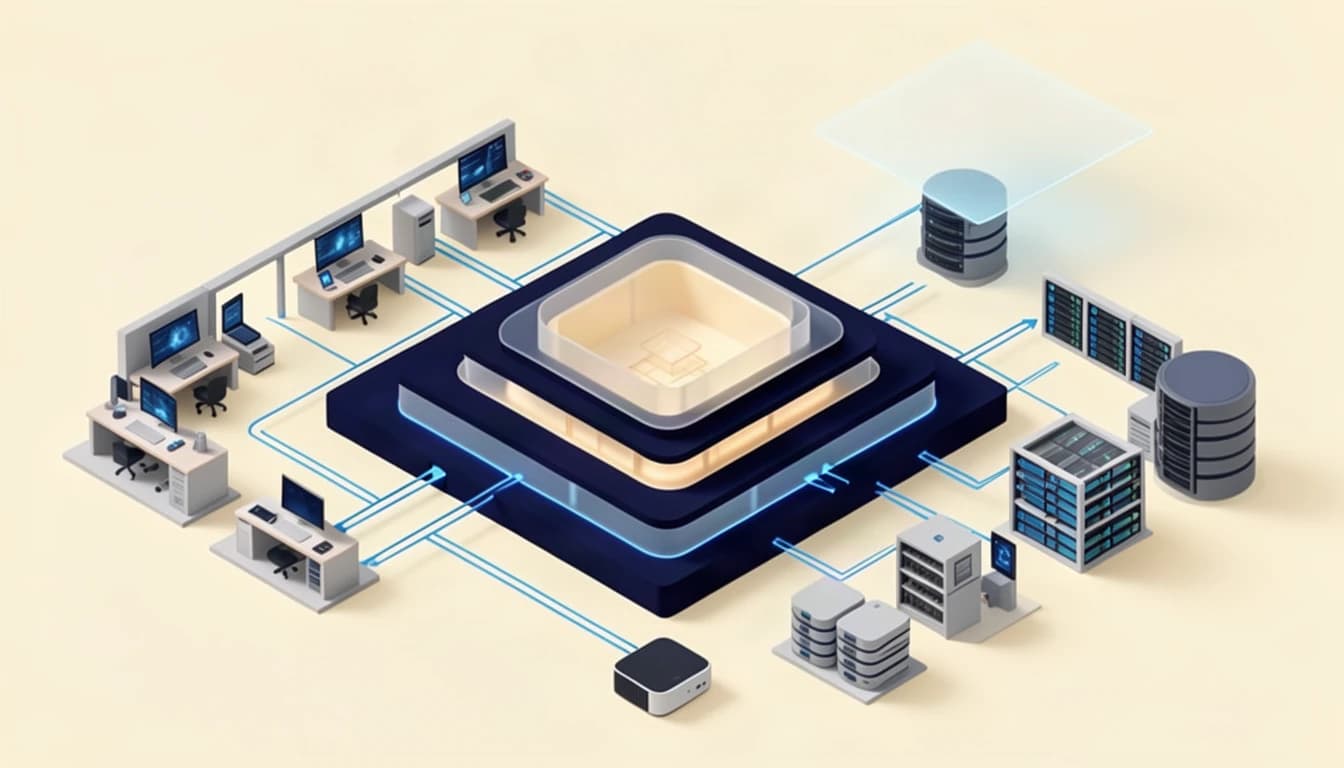
The operating loop
Automated monitoring runs continuously within the agreed scope. Human response coverage and escalation arrangements are defined in your service agreement. High-impact actions remain with authorized people.
A practical domain atlas
A practical consolidated map, not a definitive universal taxonomy. Informed by Forrester’s Zero Trust eXtended (ZTX) concept; no endorsement implied. Domains can be considered alongside NIST CSF 2.0 Govern, Identify, Protect, Detect, Respond and Recover, and applicable CIS Controls.
Leadership, policy, compliance evidence
Inventory, vulnerability assessment, authorized testing
Accounts, privileges, authentication
Workstations, servers, endpoint signals
Connectivity, segmentation, access paths
Cloud accounts, platforms, configuration
Software, interfaces, supply chain
Classification, safeguards, cryptography
Email, collaboration, human risk
SIEM context, logs, threat intelligence
Triage, investigation, incident support
Backup, continuity, restoration
Dependencies and supplier exposure
Models, agents, data and tool boundaries
Separately scoped; not default testing
Fits the environment
A physical appliance can be provisioned and shipped, or the service can be virtually hosted, after deployment design is agreed. Integration categories may include SIEM/logging, identity, endpoint, cloud, ticketing, backup and GRC evidence workflows; availability depends on provider capabilities and validation.
Onboarding starts read-only: validate integrations, permissions, coverage and deployment before any active work. Authorized internal or external vulnerability assessment and penetration testing require explicit scope.
Open-source defensive alternatives and gradual consolidation may be evaluated for fit, licensing, maintenance and coverage—not assumed replacements for your existing stack.
Monthly partnership
Different service tiers are available, tailored to your business. Coverage, integrations, responsibilities and operating cadence are agreed together during onboarding.
Authority & safeguards
Frequently asked
Yes, the security agent is fully operational and ready to be integrated to your custom environment. Scope and onboarding validate readiness.
24 Hours. Truly, it is dependent on how fast we get access to the security tooling data you already have, have our initial call to understand your architecture, and then it’s off to work.
Automated monitoring runs continuously within the agreed scope. Agentic and automated security remediation is included within your preferred authorizations and scopes. Human response coverage and escalation arrangements are defined in service agreements.
No blanket replacement. Alternatives and gradual consolidation can be evaluated only where fit, licensing, maintenance and coverage support it.
Start a conversation
What do you want to protect or improve? Bring the objective, the operating constraints, and the questions your team needs to answer.
Discuss your security use caseKeep the first conversation high level and nonsensitive.